The Babylonian Woe by David Astle
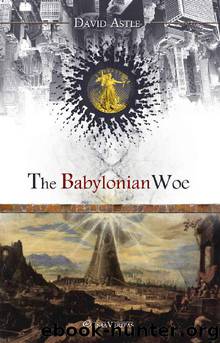
Author:David Astle [Astle, David]
Language: eng
Format: epub
Publisher: Omnia Veritas Ltd
Published: 2015-04-27T04:00:00+00:00
Pergamum And Pitane
Aristotle, author of some lucid thinking on the subject of money, if not ruthlessly penetrative, was himself married to the niece of a banker installed as co-tyrant (or “Front Man”) with another such tyrant-banker. “(Hermias the Tyrant of Assos and Atarneus) was a eunuch slave of a certain banker: he went to Athens and attended the lectures of Plato and Aristotle, and returning, he shared the tyranny of his master who had previously secured the places around Atarneus and Assos. Subsequently he succeeded him and sent for Aristotle and married his niece to him.[280]
.In this slave, banker, philosopher and despot Leaf[281] sees a tyrant who owed his position to his wealth. He quotes Euaion, the pupil of Plato, who, not far to the North at Lampsacus “lent money to the city on security of the Acropolis, and when the city defaulted, wanted to become a tyrant.”[282]
While bankers in the present dream of entrapping the whole world via their “United Nations,” in the past they contented themselves with the entrapping of a city! Just as in the present they create an entirely false picture of the nature of their operations and carefully promote the legend they are lending the public’s money, so they did in antiquity, we may rest assured. No doubt they spread exactly the same story in the time of the tyrants, and people in that day, understanding no more about money than they do today, believed it.[283] The following may be accepted as instance of their activities in ancient times.
.Pergamum, that city that arose in South West Asia Minor, lasting as independent from 283-133 B.C., was originally founded as the fortified treasury of Lysimachus, successor to Alexander in Thrace. This fort and the treasure therein amounting to 9000 talents, was in the charge of a eunuch steward named Philetairos who justified the trust reposed in him in so far as the management of this treasure was concerned. During the quarrels of the Diadochoi or Successors to Alexander, presumably at the strategic moment, he transferred his allegiance from Lysimachus to Seleucus, doubtless on condition he be guaranteed his continued position as Master of the Treasury.
Despite the murder of Seleucus by Ptolemy Keraunus, the wily Philetairos clung to the fortunes of the Seleucids, probably understanding in their particular case, the political purposes of the International Money Power of Babylonia and Alexandria in these respects, and ingratiated himself with Antiochus, son of Seleucus, by buying the body of Seleucus from Ptolemy for return to Antiochus,[284] thus, through it all maintaining his position at Pergamum.
Philetairos proceeded to use the treasure to which he had so masterfully established almost total right, with a skill which could only suggest training in the money shops of Babylonia, or Alexandria, or as close advisor, one so trained. The conception of the 9000 talents of treasure in itself being the sole maintaining force behind the extended power of Pergamum, would be quaint to say the least; as quaint indeed as the story of the 6000
Download
This site does not store any files on its server. We only index and link to content provided by other sites. Please contact the content providers to delete copyright contents if any and email us, we'll remove relevant links or contents immediately.
International Integration of the Brazilian Economy by Elias C. Grivoyannis(111320)
The Radium Girls by Kate Moore(12095)
Turbulence by E. J. Noyes(8120)
Nudge - Improving Decisions about Health, Wealth, and Happiness by Thaler Sunstein(7760)
The Black Swan by Nassim Nicholas Taleb(7198)
Rich Dad Poor Dad by Robert T. Kiyosaki(6727)
Pioneering Portfolio Management by David F. Swensen(6342)
Man-made Catastrophes and Risk Information Concealment by Dmitry Chernov & Didier Sornette(6141)
Zero to One by Peter Thiel(5873)
Secrecy World by Jake Bernstein(4804)
Millionaire: The Philanderer, Gambler, and Duelist Who Invented Modern Finance by Janet Gleeson(4539)
The Age of Surveillance Capitalism by Shoshana Zuboff(4354)
Skin in the Game by Nassim Nicholas Taleb(4309)
The Money Culture by Michael Lewis(4268)
Bullshit Jobs by David Graeber(4252)
Skin in the Game: Hidden Asymmetries in Daily Life by Nassim Nicholas Taleb(4052)
The Dhandho Investor by Mohnish Pabrai(3826)
The Wisdom of Finance by Mihir Desai(3792)
Blockchain Basics by Daniel Drescher(3641)
